United Nations
The Robot Who Looked Like MeThe United Nations is rebuilt after the Third World War as governments, driven to cooperate by hunger, food riots, and cannibalism, seek a way to feed a devastated and rapidly growing population. Its principal action in the account is to commission The Companies to solve the problem of artificial foodstuffs. That commission links a political response to catastrophe with the industrial system built around Goo, while leaving the Companies to carry out the processing and production.
Collapse and Reconstruction
The United Nations returns only after the postwar food crisis has exposed the limits of national action. Hunger Strikes and Food Riots end quickly, not because the shortage has been resolved, but because starving people are too weak to fight. Cannibalism follows. Governments, frightened by the consequences of what they have done to one another, finally band together, and the United Nations is rebuilt.
The crisis has roots in the decades before the war. During Cold War Phase II, defensive preparations included vast underground settlements, while fear had already driven population growth. Enclosed life and expanding numbers intensified pressure on food supplies. The war then compounded that pressure by killing enormous quantities of things other than people, and the ensuing ecological disruption made recovery harder still. The United Nations' reconstruction belongs to this belated political response: cooperation arrives after the emergency has become a struggle for basic survival.
Commissioning Artificial Food
The rebuilt United Nations commissions The Companies to find a solution to artificial food production, but the work proceeds slowly. The account does not describe a detailed United Nations program or specify how the commission is administered; its stated role is to call on the Companies to address the food problem. The distinction matters: political authorities establish the task, while industrial firms develop and operate the means of production.
That search takes place amid a wider ecological disaster. Radiation and bacteriological contamination carried by the Westerly Winds cross North America and the Atlantic. Fallout off the Carolinas combines with sunlight and rain, producing a mutation in the plankton-rich waters of Diamond Shoals. Within a decade of the war's end, fishermen call the new substance Goo. Initially treated as a possible menace to life in the seas, it proves capable, when killed and processed, of becoming nourishment.
From Emergency Resource to Food System
Goo offers a solution because it contains proteins, vitamins, amino acids, carbohydrates, and trace elements. Dehydrated and packaged, it can be prepared in many ways, while its flavor varies according to the patented processing system used. The Companies send harvested Goo through cracking and radiation plants, where it multiplies and is then killed and reprocessed as artificial food. The United Nations' commission thus precedes a supply chain in which a mutated marine substance becomes a mass-produced staple.
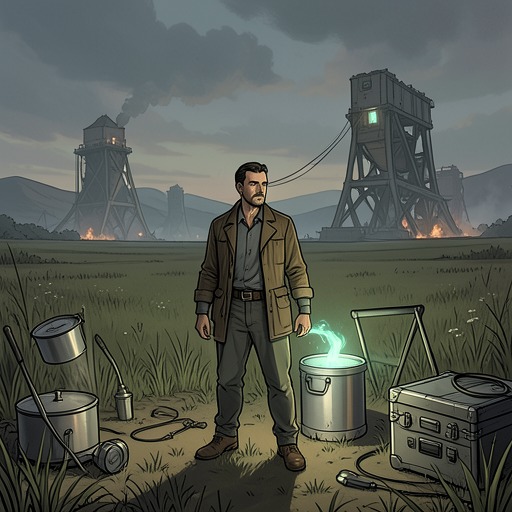
The Companies establish TexasTowers as harvesting factories and train workers to collect Goo offshore. At the processing stage, the material can multiply molecule for molecule, yielding roughly forty times its original weight after radiation. It is then ground, purified, supplemented with vitamins, colored, scented, and sold under many brand names. By the time it reaches consumers, the product has been transformed from unstable raw matter into packaged provisions for a world with twenty-seven billion people to feed.
Reach and Limits
The United Nations' commission helps make artificial food a response to a global emergency, but the account assigns the United Nations no direct role in harvesting, processing, or distribution. Those operations belong to The Companies, whose factories turn the new substance into a dependable food supply. The harvesters, meanwhile, perform arduous, high-risk work; their pay is legally classified as high-hazard pay, and they keep the world alive by gathering the material on which the food system depends.
This division of roles gives the United Nations a consequential but bounded place in the postwar order. It reappears when governments finally recognize the scale of their shared crisis and commissions industry to act. The resulting food system averts a continuing threat of starvation, yet its operation depends on corporate processing and dangerous labor. The United Nations initiates the response; it does not erase the ecological damage or the unequal risks through which survival is secured.